Dangers of online reviews
Online reviews have become one of the first places prospective patients look when researching a surgeon. They are accessible, abundant, and familiar — most people have used them to choose a restaurant or a tradesman, and the instinct to apply the same approach to choosing a surgeon is entirely understandable. But reviews of surgical practices have structural limitations that are quite different from reviews of consumer services, and placing too much weight on them when making a decision about a major, irreversible medical procedure carries real risk. This page explains what those limitations are, why they are particularly significant in cosmetic and ENT surgery, and — more importantly — what more reliable sources of information are available.
The Structural Limitations of Online Reviews
Authenticity cannot be independently verified
Most review platforms — including Google, RealSelf, and similar sites — allow reviews to be posted with minimal identity verification. There is no mechanism by which a prospective patient, or a neutral observer, can confirm that a reviewer was an actual patient of the surgeon being reviewed, that the review describes a genuine experience, or that the reviewer is who they claim to be. This creates an environment in which fabricated reviews — both positive and negative — are not only possible but documented to be common in the cosmetic surgery industry in Australia and internationally.
Positive fake reviews can be generated by a practice’s own staff or marketing contractors, by individuals receiving incentives (discounts, complimentary services, commissions), or by review-generation services that charge fees for producing favourable ratings. Negative fake reviews can be posted by competitors, by disgruntled former employees, or by individuals who have never been patients at all. Without any verification mechanism, the aggregate star rating of a surgical practice tells you nothing about how these proportions break down in any particular case.
Authentic reviews measure the wrong things
Even setting aside the authenticity problem entirely and assuming that every review on a platform is genuine and well-intentioned, the content of most surgical practice reviews reflects factors that are entirely disconnected from surgical quality. A typical review addresses: how easy the appointment booking process was, the pleasantness and attentiveness of reception staff, waiting times, car parking, the décor and cleanliness of the consulting rooms, and the surgeon’s bedside manner and communication style. These are legitimate and important aspects of the patient experience — but they are not proxies for technical surgical skill, anatomical knowledge, or the quality of outcomes.
A surgeon who is warm, unhurried, and highly communicative but whose technical outcomes are mediocre will tend to attract excellent reviews. A surgeon who is reserved and business-like but who consistently produces exceptional technical results may attract middling reviews. The correlation between the things that drive positive reviews and the things that constitute surgical excellence is imperfect at best.
Patients cannot evaluate technical quality
This is perhaps the most fundamental limitation. A patient who is pleased with their rhinoplasty result has no clinical basis on which to determine whether that result was technically excellent, merely adequate, or in fact suboptimal by objective surgical standards — they simply feel that they look better than they did before. Conversely, a patient who is dissatisfied with their result may be responding to a technically well-executed procedure that did not meet their pre-operative expectations, rather than to any surgical deficiency. Patient satisfaction and objective surgical quality are correlated but not equivalent, and the distinction matters enormously when using reviews as a proxy for the latter.
This limitation is amplified in rhinoplasty and facial surgery by the very long timescale of results. A rhinoplasty result cannot be meaningfully assessed before twelve to eighteen months post-operatively. A patient who posts a glowing review at two months — before residual swelling has resolved — is not reviewing the final outcome. A patient who posts a negative review at three months — during the difficult intermediate recovery phase, when supra-tip swelling and temporary irregularities are expected — may be describing a normal healing process rather than a poor outcome.
Reviews over-represent extreme experiences
The mechanism by which reviews are generated is not random. Patients who had an exceptionally positive or exceptionally negative experience are substantially more likely to write a review than patients who had a satisfactory, unremarkable one. This selection effect means that the visible review corpus on any platform systematically over-represents outliers — at both ends of the spectrum — and under-represents the broad middle of actual patient experiences. A practice with a small number of five-star reviews and one strongly negative review may simply reflect this selection effect rather than the genuine distribution of patient outcomes.
Surgeons cannot respond to individual reviews in Australia
In Australia, the Medical Board’s guidelines under the Health Practitioner Regulation National Law effectively prevent medical practitioners from responding publicly to individual patient reviews in a way that would identify or provide information about the patient. This means that the public record — even for a review that is demonstrably inaccurate, misleading, or written by someone who was never a patient — consists only of the review itself, with no clinical context, no opportunity for the practitioner to correct factual errors, and no account of the circumstances from the clinical side. A one-star review alleging negligence may remain on a platform indefinitely, with no visible response, regardless of its accuracy. This asymmetry is unique to medical practice and not widely understood by patients who are familiar with the review response culture in consumer industries.
Reviews are temporally unstable
A cluster of positive reviews from two or three years ago says nothing about the current standard of care at a practice. Staff change. Techniques evolve — or stagnate. Hospital affiliations change. The quality of a surgical practice at the time reviews were written may bear little relationship to its current standard in either direction. Equally, a more recent negative review may reflect an isolated atypical experience rather than a systemic quality problem. The date of reviews matters enormously and is rarely given appropriate weight.
What More Reliable Sources of Information Look Like
The AHPRA Register — the only publicly verified source
The Australian Health Practitioner Regulation Agency (AHPRA) maintains a publicly searchable register of all registered medical practitioners in Australia. This register provides factual, verified information: the practitioner’s registration status (current or otherwise), their specialist field (or absence thereof), the type of registration held, and any conditions, undertakings, reprimands, or restrictions on their practice. This is the single most reliable piece of publicly available information about any medical practitioner in Australia, and it takes minutes to access.
Verify any surgeon you are considering at ahpra.gov.au. Confirm that their registration is current, that their specialist field matches the procedure you are considering, and that there are no conditions or restrictions on their practice. This is a minimum baseline check that every prospective surgical patient should perform.
Fellowship training in the specific procedure
Specialist surgical registration — FRACS — is a prerequisite for independent surgical practice in a given specialty, but it is not specific to individual procedures within that specialty. A surgeon with FRACS (Plastics) is registered to practise plastic surgery broadly; that registration does not indicate specific training, volume, or expertise in rhinoplasty, or facelift, or any other individual procedure within the specialty. The same is true for FRACS (ORL-HNS) and other surgical fellowships.
The most informative question you can ask a surgeon is not “Are you a specialist?” but “Where did you receive specific training in this procedure, how long was that training, and with whom did you train?” A rhinoplasty surgeon who completed a dedicated twelve-month rhinoplasty fellowship at a major international centre brings a fundamentally different depth of specific training than one who learned the procedure incidentally during a general plastic surgery or ENT training programme. Ask the question and expect a specific answer — the name of the programme, the institution, the duration, and the supervisor. Inability to give a clear answer is itself informative.
Operative volume — how many, and how often
In surgical disciplines, technical skill is substantially volume-dependent — particularly for complex procedures like rhinoplasty and deep plane facelift where the range of anatomical presentations is wide and the margin for error is narrow. Ask your surgeon directly how many of the specific procedure they perform per year. Nationally and internationally, a rhinoplasty surgeon performing more than 100 to 150 cases per year is considered high volume; one performing fewer than 30 to 40 per year is practising the procedure infrequently. High volume is not sufficient on its own — it must be accompanied by good training and good judgment — but it is a meaningful positive indicator.
Continuing education and engagement with evolving technique
Surgical techniques evolve. Rhinoplasty in particular has undergone fundamental changes in the past decade — the emergence of dorsal preservation rhinoplasty represents a paradigm shift that has substantially altered how many experienced surgeons approach the procedure. A surgeon whose training predates this development and who has not actively engaged with it in their continuing education programme is not practising contemporary rhinoplasty. Ask what courses, conferences, cadaveric workshops, and surgical education programmes your surgeon has engaged with in the past two to three years. Active engagement with the current literature and contemporary technique is a meaningful differentiator.
Hospital accreditation and credentialling
Surgeons who operate at accredited private hospitals must hold credentials at those institutions — a process that involves assessment of their training, their professional standing, their insurance, and their clinical governance record. Operating privileges at a reputable, accredited private hospital reflect a baseline professional standard that is independently assessed. A surgeon who operates exclusively in their own in-rooms facility — without hospital credentials — has not been subject to the credentialling scrutiny that hospital practice requires. This distinction matters, particularly for procedures performed under general anaesthesia.
The consultation itself — the most direct assessment available
A well-conducted consultation is the most direct and reliable assessment available to a prospective patient. During a consultation, you can directly observe: whether the surgeon listens carefully and asks detailed questions about your specific concerns and goals; whether they conduct a thorough clinical examination; whether they give you an honest, specific, and candid account of what they can and cannot achieve for your anatomy; whether risks are discussed clearly and specifically; whether they encourage you to take time, ask questions, and seek a second opinion; and whether the overall tone of the interaction feels like genuine clinical care or primarily like a sales process. The quality of a consultation is an honest signal of the quality of the clinical care that follows it.
Any reputable surgeon will welcome a second opinion before a major elective procedure. If a surgeon appears uncomfortable with this, or creates urgency around a decision, that is itself an important piece of information.
About Dr Roth’s Practice
Dr Jason Roth (MED0001185485) is a Specialist Otolaryngologist and Head and Neck Surgeon (FRACS ORL-HNS) with subspecialty fellowship training in rhinoplasty from Rush University Medical Center, Chicago (American Rhinologic Society Fellowship) and in facial plastic surgery from the Academic Medical Center, Amsterdam. He holds the International Board Certification in Facial Plastic and Reconstructive Surgery and serves on the board of the Australasian Academy of Facial Plastic Surgery. His AHPRA registration can be verified at any time at ahpra.gov.au — registration number MED0001185485.
How to Choose a Rhinoplasty Surgeon → | About Dr Roth → | Arrange a Consultation →
Dr Roth’s Clinical Perspective
Online reviews are one of the factors I am most frequently asked about at consultation, and my honest position is that they should be one of the least weighted factors in choosing a surgeon for a complex elective procedure. A five-star rating reflects patient satisfaction with the overall experience — the rooms, the staff, the communication — more reliably than it reflects surgical outcomes, which take twelve months or more to fully assess and which most patients do not return to review. The qualifications, training, volume, and scope of practice of the surgeon are verifiable and meaningful. The aggregate rating is not.
— Dr Jason Roth, MBBS, FRACS (ORL-HNS), IBCFPRS
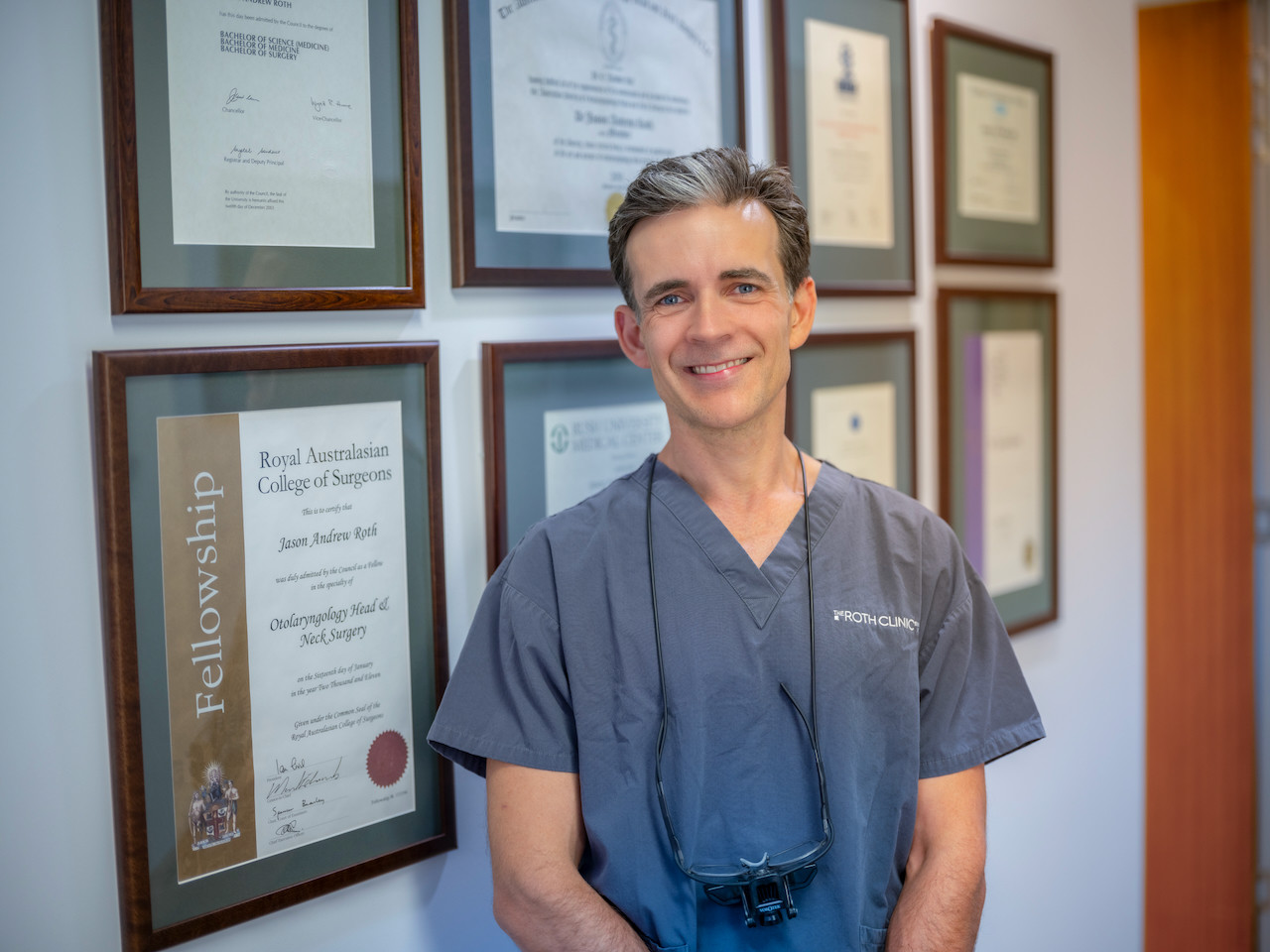
Specialist Otolaryngologist & Head and Neck Surgeon
Specialist registration — Otorhinolaryngology, Head & Neck Surgery
View full profile
