
Platysmaplasty
All cosmetic surgery involves risks and individual results vary. Cosmetic surgery is a serious decision. Decisions about whether to proceed should be made after careful consideration and following at least two consultations with a qualified medical practitioner.
A platysmaplasty is a surgical procedure that tightens and repositions the platysma muscle — the broad, thin muscle that lies just beneath the skin of the neck and lower jaw. It is performed to address vertical muscle banding and generalised laxity in the neck, and may be performed as a standalone procedure or as part of a broader neck lift.
Cosmetic surgery is a serious decision — read the full facelift and neck lift risks page →
What is the Platysma Muscle?
The platysma is a large, sheet-like muscle extending from the chest and shoulder up through the neck to the lower jaw and facial muscles. There is typically a gap in the midline between the two halves of the platysma. With age, this gap widens and the muscle descends, contributing to visible vertical bands in the neck, generalised neck fullness, and jowling along the jawline and chin.

What Does a Platysmaplasty Involve?
A platysmaplasty involves tightening and elevating the platysma muscle. A small incision (approximately 1–3 cm) is made under the chin, through which the separated medial edges of the platysma are identified and sutured together in the midline — a procedure sometimes called a corset platysmaplasty or midline platysma plication. Dr Roth uses fibreoptic telescopes in a keyhole manner to identify the muscle and any excess submental fat, with liposuction performed at the same time where appropriate.
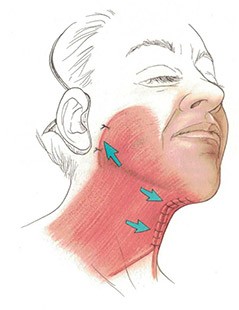
The platysma can also be elevated from an additional incision hidden around the ear to further address skin laxity and jowling — at this point the procedure is most accurately described as a neck lift. Whether midline plication alone is sufficient, or whether lateral elevation from the ear is also needed, depends on individual anatomy and is assessed at consultation.
A platysmaplasty addresses changes in the neck but does not treat changes in the midface, eyelids, or brow. These are separate anatomical regions requiring separate assessment and, if indicated, separate procedures.
Recovery
On waking from surgery the neck will feel tight — this is expected and gradually settles as healing progresses. Most patients require a few days of downtime. Some bruising and swelling along the jawline and neck may take one to two weeks to subside. The procedure is performed under general anaesthesia.
Contact us to arrange a consultation → | Neck Lift Surgery → | Deep Plane Facelift →
Dr Roth’s Clinical Perspective
Platysmal banding is an important consideration in neck assessment, but it is not the only structure that determines the neck contour — and over-focusing on the bands can lead to inadequate attention to the subplatysmal fat, the digastric muscles, and the submandibular glands, which all contribute to the final appearance. I assess the neck systematically at every facelift consultation, and the platysmaplasty component is planned as part of the complete neck management rather than as a standalone operation.
— Dr Jason Roth, MBBS, FRACS (ORL-HNS), IBCFPRS

Specialist Otolaryngologist & Head and Neck Surgeon
Specialist registration — Otorhinolaryngology, Head & Neck Surgery
View full profile
