
Voyant Neck Lift
All cosmetic surgery involves risks and individual results vary. The outcomes shown in any images on this page are relevant only to the specific patient depicted and do not reflect the results that other patients may experience. Cosmetic surgery is a serious decision. Decisions about whether to proceed should be made after careful consideration and following at least two consultations with a qualified medical practitioner.
Achieving a truly defined jawline often requires more than skin tightening. Dr Jason Roth uses the Voyant Intelligent Energy System — an advanced bipolar sealing and cutting device — to safely address the deep structures of the neck that conventional techniques cannot adequately treat.
Why Deep Structure Management Defines the Result
The appearance of an ageing or poorly defined neck is rarely caused by skin laxity alone. In the majority of patients presenting with submandibular fullness, the underlying cause lies deeper — in enlarged salivary glands, excess subplatysmal fat, or bulky digastric muscles that protrude beneath the chin, particularly when the head is tilted forward.
Addressing only the superficial layers — through liposuction or skin tightening — frequently produces short-lived results, or worse, accentuates underlying structural fullness that was previously concealed by subcutaneous fat. The most natural and durable outcomes in neck rejuvenation are achieved when the deep structures are contoured precisely and safely before the skin and platysma are redraped under minimal tension.
Research demonstrates that in up to 85% of individuals, ageing produces perifacial expansion rather than facial thinning. The submandibular glands alone may account for nearly a quarter of total neck soft tissue volume — and they enlarge further with age, weight gain, and alcohol consumption. A neck lift that ignores these structures is incomplete.
The Anatomy of Neck Fullness — Three Zones, Three Layers
The submandibular region is divided into three distinct anatomical zones, each requiring a different approach:
Why Not All Surgeons Address the Submandibular Gland
Many surgeons performing neck lift surgery elect not to reduce or partially excise the submandibular glands. This is an understandable position — the submandibular triangle is a surgically demanding region, densely populated by important structures including the marginal mandibular branch of the facial nerve, the lingual and hypoglossal nerves, the facial artery and its intraglandular perforators, and the retromandibular vein.
Incomplete neck surgery carries its own risks. Removing subcutaneous and subplatysmal fat without reducing prominent submandibular glands simply unmasks the underlying glandular fullness, often leaving the patient worse off than before. This is a common finding in patients who present to Dr Roth having undergone submental liposuction or a previous neck lift elsewhere.
The key to safely performing submandibular gland reduction lies in surgical experience, meticulous haemostasis, and the use of appropriate instrumentation. The Voyant Intelligent Energy System provides exactly this — allowing precise, controlled dissection and sealing of the highly vascular glandular tissue in a confined anatomical space.
Dr Roth is a Specialist Otolaryngologist, Head and Neck Surgeon, and Facial Plastic Surgeon — a combination that is uniquely suited to this work. His training in the surgical anatomy of the neck, salivary glands, and cranial nerves means that deep neck dissection is not unfamiliar territory. It is the foundation of his surgical practice.
The Voyant Intelligent Energy System (Advanced Bipolar EB230)
The Voyant system, developed by Applied Medical, represents a significant advance in advanced bipolar vessel sealing and tissue fusion technology. Dr Roth uses the Voyant Fine Fusion device — a purpose-designed open instrument for use in head and neck surgery — in combination with the Voyant Electrosurgical Generator at Wyvern Private Hospital.
Unlike conventional monopolar electrocautery, which transmits electrical energy broadly through tissue, the Voyant system delivers precise, controlled radiofrequency energy exclusively to the tissue captured between its jaws. The generator continuously monitors tissue impedance and modulates energy delivery in real time, achieving reliable vessel sealing and tissue fusion with minimal lateral thermal spread.
Intelligent Energy Delivery
The generator continuously samples tissue characteristics and adjusts energy output in real time — terminating the cycle automatically when a consistent tissue seal is confirmed. This prevents overheating and reduces thermal injury to adjacent structures.
Reliable Vessel Sealing
The Fine Fusion device seals vessels up to 7mm in diameter — encompassing the intraglandular perforators of the facial artery that represent the principal bleeding risk during submandibular gland reduction.
Designed for Head & Neck Surgery
The Fine Fusion instrument features slim, refined jaws specifically engineered for procedures where working space is limited — critical within the submandibular triangle, where the marginal mandibular nerve lies in close proximity.
Simultaneous Seal and Divide
A user-actuated blade allows the surgeon to divide sealed tissue without changing instruments — maintaining operative efficiency and reducing the number of steps required to manage vascular pedicles safely.
Available at Wyvern Private Hospital, North Shore Private Hospital & Castlecrag Private Hospital
What to Expect — The Surgical Process
Patients Who Benefit Most from Deep Neck Lift
The deep reduction neck lift with the Voyant system is not the appropriate procedure for every patient. The following presentations are those in which Dr Roth most commonly recommends this approach:
- Type II Facial Ageing — Patients demonstrating perifacial expansion with submandibular and jawline fullness, where tightening procedures alone will not achieve adequate definition.
- Hereditary Neck Fullness — Younger patients with constitutionally heavy or obtuse necks — often with enlarged submandibular glands — who have been unsuccessfully treated with non-surgical methods or submental liposuction alone.
- Previous Neck Surgery with Suboptimal Results — Patients with an underdone or overdone-face-underdone-neck deformity following facelift or liposuction, where inadequate attention was paid to the deep structures.
- Cobra Neck Deformity — Patients who have undergone aggressive submental defatting, leaving a central depression flanked by persistent submandibular fullness from unaddressed glands.
- Patients Seeking a Natural Result in Dynamic Positions — Those who want a result that looks natural not only in photographs but when looking down — at a menu, at a phone, or across a meeting table.
- Men with Heavy Neck Anatomy — Male patients, in whom the platysma is often thicker and the submandibular structures more prominent, frequently require deep structure reduction to achieve adequate cervical contouring.
Frequently Asked Questions
Common questions about the Voyant deep neck lift procedure answered by Dr Jason Roth, Specialist Otolaryngologist and Head and Neck Surgeon, Sydney.
The Voyant system is an advanced bipolar tissue fusion and vessel sealing platform developed by Applied Medical. The generator (EB230) continuously monitors tissue impedance and delivers precisely calibrated radiofrequency energy through the Fine Fusion device — a slim-jawed instrument designed for open head and neck procedures. It seals vessels up to 7mm in diameter and divides tissue simultaneously via a built-in blade, providing reliable haemostasis in a compact, precise instrument. Unlike conventional monopolar diathermy, it minimises lateral thermal spread, making it substantially safer when operating close to important nerves and vessels.
The submandibular glands enlarge with age, weight gain, alcohol consumption, and other factors. Studies have demonstrated that they may account for up to 24.5% of the total subcutaneous soft tissue volume of the neck, and they gradually migrate downwards with age. When enlarged, they produce a characteristic bilateral fullness below and medial to the mandibular border that cannot be reduced by liposuction, non-surgical fat reduction, or skin tightening. CT and MRI imaging often reveal that what patients perceive as fat is, in fact, predominantly glandular tissue.
Partial submandibular gland reduction — the removal of only the portion of the gland extending below the mandibular border — has been well documented in the aesthetic surgery literature and does not cause dry mouth (xerostomia). This is an important distinction from the oncological literature, where complete gland excision in the context of radiotherapy is associated with dry mouth — a complication caused by the radiation rather than the gland removal itself. The remaining gland tissue, along with the parotid glands, provides fully adequate salivary function. A systematic review of the evidence confirms that partial aesthetic submandibular gland reduction does not impair salivary gland function when performed for cosmetic indications.
The marginal mandibular branch of the facial nerve — which controls movement of the corner of the mouth — lies on the lateral surface of the submandibular gland capsule and is the principal nerve at risk during this procedure. Transient weakness of the lower lip depressors occurs in up to 4% of patients undergoing partial submandibular gland reduction in the context of facelift surgery — comparable to the nerve weakness rates associated with facelift procedures in general. Permanent weakness is uncommon in experienced hands. The Voyant system’s controlled energy delivery and the Fine Fusion device’s precise jaw geometry reduce the risk of inadvertent thermal nerve injury significantly compared with conventional monopolar diathermy.
A sialocele is a subcutaneous collection of saliva that can develop following partial submandibular gland reduction. It occurs in approximately 2% of patients. It presents as a soft, fluctuant swelling beneath the skin in the first few weeks after surgery and is managed with simple aspiration in the clinic, sometimes combined with botulinum toxin injection into the residual gland stump to temporarily suppress salivary secretion. The incidence is minimised by intraoperative botulinum toxin injection, careful gland capsule closure, adherence to a low-salivary-stimulation diet for the first five days, and the use of closed suction drains. It is a self-limiting condition and does not affect the final result.
The Connell view refers to the profile view with the chin directed downward, as occurs naturally when looking at a menu, a phone, or a document. In this position, the submandibular glands and anterior belly of the digastric muscles are displaced downwards and outward, creating a pronounced double chin or submental bulge in patients with untreated deep structures. Many neck lift results that appear satisfactory in frontal and profile views at rest deteriorate markedly in the Connell view. Dr Roth considers this a standard assessment position for all neck lift patients and regards a natural result in this view as a non-negotiable objective of the procedure.
When submandibular gland reduction is performed as part of the neck lift, Dr Roth recommends an overnight stay at Wyvern Private Hospital. The primary reason is the small but meaningful risk of acute postoperative haemorrhage from intraglandular facial artery perforators in the immediate hours after surgery. Nursing observation overnight allows any such event to be identified and managed promptly. For neck lift procedures not involving significant glandular work, day surgery may be appropriate, which is discussed individually at consultation.
Most patients are comfortable for discharge the morning after surgery. Bruising and swelling are expected for two to three weeks. The majority of patients return to desk-based work within ten to fourteen days and to full activity, including exercise, within four to six weeks. NSAIDs, alcohol, and vigorous exercise should be avoided for two weeks to minimise bleeding risk. Drains are typically removed on the fifth postoperative day. Most patients find that the swelling settles sufficiently within three to four weeks to feel confident in social settings, with continued improvement in definition over the following three months.
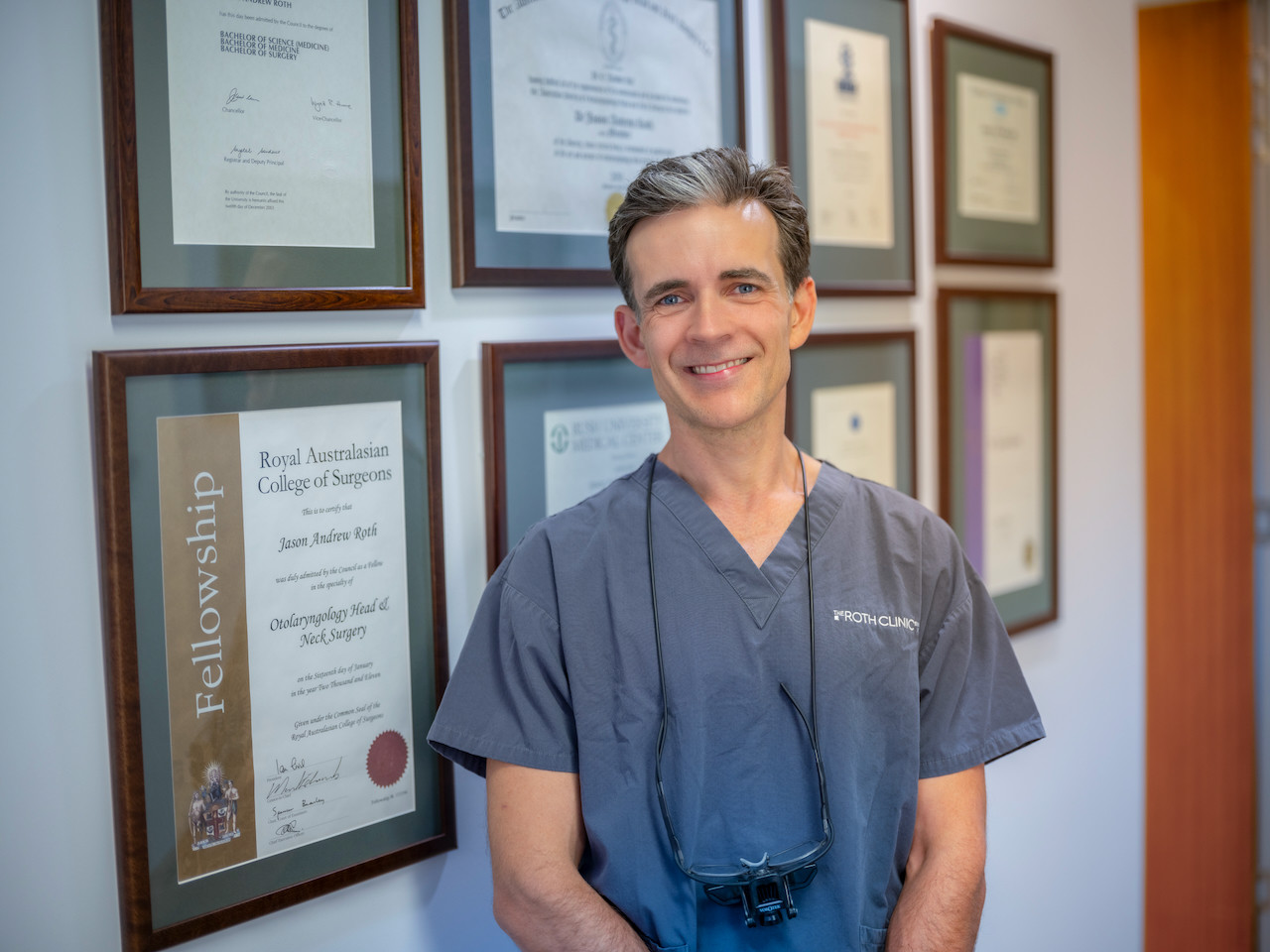
Dr Roth’s Clinical Perspective
The Voyant neck lift addresses patients who have significant submental and neck concerns but who are not yet at the stage of, or are not appropriate candidates for, a full deep plane facelift. The key to a good result with this approach is the same as with any neck procedure: thorough assessment of the subplatysmal structures. Patients with prominent digastric muscles, significant subplatysmal fat at multiple levels, or early submandibular gland ptosis need those structures addressed directly — liposuction and skin tightening alone will not produce a defined jawline if the subplatysmal anatomy is not managed.
— Dr Jason Roth, MBBS, FRACS (ORL-HNS), IBCFPRS
Specialist Otolaryngologist & Head and Neck Surgeon
Specialist registration — Otorhinolaryngology, Head & Neck Surgery
View full profile
