
Narrow Nose
All cosmetic surgery involves risks and individual results vary. Cosmetic surgery is a serious decision. Decisions about whether to proceed should be made after careful consideration and following at least two consultations with a qualified medical practitioner.
A narrow nose is less commonly a presenting concern than a wide nose, but occurs in two distinct clinical contexts — as a primary characteristic of the nose, or as a complication of previous rhinoplasty in which the nose was narrowed excessively. In both cases, narrowness may affect both the appearance and the nasal airway, as a narrow external nose is frequently associated with a compromised internal nasal valve.
All surgery carries risks — read the full rhinoplasty risks page →
Assessment of Nasal Width
The width of the nose is assessed at three levels — the bony upper third, the cartilaginous middle third, and the lower third including the tip and alar base. Each may be narrow independently or in combination.
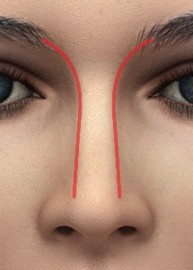
Brow-tip aesthetic line — should be smooth and uninterrupted on each side

Facial vertical fifths — nasal width in proportion to facial width
A useful clinical reference is the brow-tip aesthetic line — the smooth, gently curved line that should extend from the medial brow down to the nasal tip on each side. Narrowing of the middle or lower third disrupts this line and is clearly visible on frontal view. Nasal width can also be assessed in proportion to facial width — the nasal base is generally approximately one fifth of the total facial width, though this varies considerably between individuals and ethnic backgrounds.
Causes
- Primary narrow middle third — the upper lateral cartilages are naturally positioned close to the septum, narrowing the internal nasal valve and producing a narrow middle third appearance
- Post-rhinoplasty — excessive osteotomies that have moved the nasal bones too far inward, or a cephalic trim that has weakened and collapsed the lateral crura, can produce a nose that is narrower than intended
- Scarring and contracture — scar tissue following surgery can progressively narrow the nose over time as it contracts
Surgical Treatment
The most common site of narrowing is the middle third, which can be effectively widened using spreader grafts — cartilage grafts placed between the nasal septum and upper lateral cartilages that push the lateral cartilages outward, widening both the external nasal appearance and the internal nasal valve simultaneously.
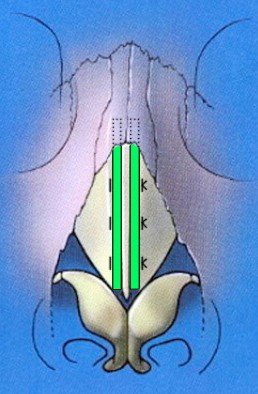
Spreader grafts — the primary technique for widening a narrow middle third
For narrowness of the bony upper third resulting from over-aggressive osteotomies, the nasal bones may need to be re-fractured and repositioned outward — a technically demanding revision procedure. Narrowness of the lower third and alar region is addressed through lateral crural strut grafts or alar batten grafts.
Contact us to arrange a consultation → | Spreader Grafts → | Nasal Valve Collapse → | Rhinoplasty Risks →
Dr Roth’s Clinical Perspective
A narrow nose consultation is somewhat different from a wide nose consultation — patients often do not want their nose made wider, but they are bothered by something specific about the narrow appearance that they find difficult to describe. The most useful assessment is the basal view: a narrow nose often has a pinched, asymmetric, or retracted alar rim quality that is the actual concern rather than overall width. Understanding what specifically is bothering the patient — and whether it has a structural explanation that surgery can address — is more useful than simply noting “narrow” on assessment and proposing spreader grafts.
— Dr Jason Roth, MBBS, FRACS (ORL-HNS), IBCFPRS

Specialist Otolaryngologist & Head and Neck Surgeon
Specialist registration — Otorhinolaryngology, Head & Neck Surgery
View full profile
