Short Nose Surgery
All cosmetic surgery involves risks and individual results vary. Cosmetic surgery is a serious decision. Decisions about whether to proceed should be made after careful consideration and following at least two consultations with a qualified medical practitioner.
A short nose — characterised by an upwardly rotated tip and reduced nasal length — is among the more challenging problems in rhinoplasty. It can be a primary feature present since early development, a consequence of nasal birth trauma, or result from a previous rhinoplasty in which the tip was over-rotated or too much cartilage was removed, causing progressive retraction of the skin envelope over time.
All surgery carries risks — read the full rhinoplasty risks page →
Assessment
Nasal length is assessed in the context of the individual’s overall facial proportions — what constitutes a short nose on one face may appear proportionate on another. Length is measured from the root of the nose (the deepest point between the eyes) to the tip-defining points. A short nose typically has excessive upward rotation of the tip — the nasolabial angle (the angle between the columella and the upper lip) is greater than ideal — and may show excessive nostril visibility on frontal view.
A low radix can also create the appearance of a short nose even when the true nasal length is adequate, by lowering the starting point of the nose relative to the eyes. In these cases, augmenting the radix with a graft may be more appropriate than tip-lengthening surgery.
Why Is This Difficult to Correct?
Lengthening a short nose is technically challenging for several reasons:
- The nasal skin envelope must stretch to accommodate an elongated framework — skin that has contracted over time following previous surgery may be resistant to this, and excessive tension on the skin risks compromising blood supply
- Where previous surgery has scarred the soft tissue, releasing those adhesions and creating adequate mobility for the tip to be repositioned is demanding
- The new tip position must be strongly supported with cartilage grafts, or it will return toward its original position as healing and contracture occur over the following months and years
- In revision cases, septal cartilage may already have been harvested, requiring rib cartilage — a more complex graft with its own handling and warping considerations
If considering revision rhinoplasty for an over-rotated tip, it is generally advisable to allow the nasal skin to relax as fully as possible before proceeding — though the skin will continue to contract over time, making very long delays counterproductive.
Surgical Techniques
Caudal Septal Extension Graft
A straight piece of cartilage — typically from the septum or rib — is sutured to the front edge of the nasal septum to extend its length downward and forward. The tip cartilages are then sutured to the lower end of this graft in their new, less-rotated position. This creates a very stable structural platform for the repositioned tip and is the most reliable technique for lengthening the nose and counter-rotating an upturned tip.
Extended Spreader Grafts
Spreader grafts that extend beyond the middle third of the nose down into the tip region can be used to both lengthen the nose and provide a stable anchor for the tip cartilages in a lower position. When stitched to the tip cartilages they can contribute to tip counter-rotation while also widening the internal nasal valve.
Radix Grafting
Where a low radix is contributing to the appearance of a short nose by lowering the starting point of the nasal bridge, a cartilage graft placed at the radix can increase the apparent length of the nose without requiring tip repositioning.
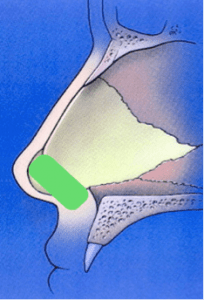
Caudal septal extension graft — extends septal length to allow tip repositioning
Contact us to arrange a consultation → | Revision Rhinoplasty → | Rhinoplasty Risks →
Dr Roth’s Clinical Perspective
Short nose correction is among the more technically demanding rhinoplasty goals because increasing nasal length and de-rotating the tip requires structural grafting — specifically caudal extension grafts — and the result needs to be stable at five and ten years, not just at six months. The grafts I use for significant lengthening are placed as a strong internal scaffold that resists the scar contracture that would otherwise pull the tip back up over time. I am direct with patients about what degree of lengthening is anatomically achievable in their specific nose, because the skin envelope limits how far the tip can be moved inferiorly.
— Dr Jason Roth, MBBS, FRACS (ORL-HNS), IBCFPRS

Specialist Otolaryngologist & Head and Neck Surgeon
Specialist registration — Otorhinolaryngology, Head & Neck Surgery
View full profile
