
Spreader Grafts
Spreader grafts are one of the most important and widely used techniques in rhinoplasty. First described by Jack Sheen in 1982, they marked a shift in rhinoplasty philosophy from predominantly reductive approaches toward techniques that augment and preserve nasal structure. They are used in both functional and cosmetic rhinoplasty for a range of specific indications.
What Are Spreader Grafts?
Spreader grafts are small, precisely carved strips of cartilage placed between the nasal septum and the upper lateral cartilages — one on each side, though they may be used asymmetrically where correction of one side is needed. They are typically harvested from the nasal septum (first preference), though rib or ear cartilage may be used if septal cartilage is unavailable.
The autospreader flap — a technique where the upper lateral cartilages themselves are folded inward to recreate the function of a spreader graft — has become a popular alternative that avoids the need for a separate graft harvest in appropriate anatomy.
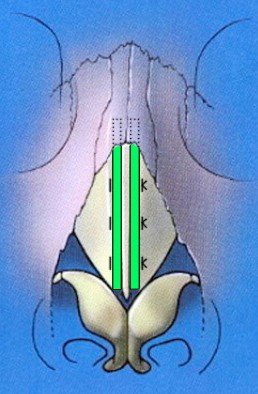
Spreader graft position between septum and upper lateral cartilages
When Are Spreader Grafts Used?
1. After Dorsal Hump Reduction
When a dorsal hump is removed, the junction between the upper lateral cartilages, the nasal septum, and the nasal bones is disrupted. Without support, these structures have a tendency to collapse inward over time — producing an inverted V deformity visible on the nasal bridge. Spreader grafts stabilise the middle third and prevent this collapse. Patients with short nasal bones, thin skin, and long cartilages are at particular risk and should always have spreader grafts placed when a dorsal reduction is performed.
2. To Improve the Internal Nasal Airway
The internal nasal valve is the narrowest point of the nasal airway. Spreader grafts widen the internal nasal valve by pushing the upper lateral cartilage laterally away from the septum. Even small increases in the cross-sectional area at the internal valve can produce significant improvements in airflow. This is one of the most reliable surgical approaches to internal nasal valve stenosis.
3. To Address Middle Third Asymmetry
An asymmetric middle third of the nose — where one side projects more than the other — can be addressed using a single spreader graft on the deficient side. The graft fills in the concavity and restores a straighter dorsal aesthetic line, while simultaneously improving the internal nasal valve on that side.
4. To Reconstruct a Collapsed Middle Third
Following trauma or previous surgery, the middle third of the nose may have collapsed or lost adequate support. Spreader grafts can be used to rebuild the dorsal structure and restore the anatomical connection between the nasal bones and the cartilaginous framework.
How Are They Inserted?
Spreader grafts are most commonly placed through an open approach rhinoplasty, where direct visualisation allows precise positioning and secure suture fixation. They can also be placed through a closed approach in selected cases.
If you are having a dorsal hump reduction as part of your rhinoplasty, always ask your surgeon whether spreader grafts are planned. Their routine use at the time of dorsal reduction is an important measure to protect the airway and prevent long-term structural changes to the nose.
Contact us to arrange a consultation → | Rhinoplasty Surgery → | Nasal Valve Collapse →
Dr Roth’s Clinical Perspective
Spreader grafts are one of the most reliably functional rhinoplasty techniques — they address the internal nasal valve directly and the improvement in nasal airflow is consistent. I use them routinely whenever the dorsum is reduced, because dorsal hump removal opens the osseocartilaginous roof and disrupts the internal valve angle. Failing to reconstruct this with spreader grafts is one of the most common causes of post-rhinoplasty nasal obstruction and inverted-V deformity. The decision about graft dimensions and placement is made intraoperatively based on the valve angle achieved, not from a fixed protocol.
— Dr Jason Roth, MBBS, FRACS (ORL-HNS), IBCFPRS

Specialist Otolaryngologist & Head and Neck Surgeon
Specialist registration — Otorhinolaryngology, Head & Neck Surgery
View full profile
