
Wide Nasal Bridge
All cosmetic surgery involves risks and individual results vary. Cosmetic surgery is a serious decision. Decisions about whether to proceed should be made after careful consideration and following at least two consultations with a qualified medical practitioner.
The width of the nasal bridge — the bony upper third of the nose — is determined by the width and angulation of the paired nasal bones. Patients seeking narrowing of the nasal bridge are assessed at consultation to determine the contributing anatomy and the most appropriate surgical approach.
All surgery carries risks — read the full rhinoplasty risks page →
What Causes a Wide Nasal Bridge?
A wide nasal bridge most commonly arises from the natural width or angulation of the nasal bones. It can also appear more prominent where the nasal dorsum is low — as the nose is viewed relative to its surroundings, a low bridge can appear wide even if the actual bone width is proportionate. This is particularly relevant in rhinoplasty planning for patients of non-European backgrounds, where dorsal augmentation may be more appropriate than narrowing.
A wide appearance can also develop after dorsal reduction rhinoplasty if the open roof created by removing the dorsal hump is not adequately closed — this is called an open roof deformity, and is prevented by performing osteotomies (controlled bone fractures) to narrow and close the roof at the time of dorsal reduction.
Surgical Approach — Osteotomies
Narrowing of the nasal bridge is performed through osteotomies — controlled fractures of the nasal bones that allow them to be moved inward to a narrower position. The osteotomies are made using a small instrument and are precisely planned to avoid disrupting the nasal bones beyond the intended area.
Before any narrowing procedure is planned, it is important to assess the nasal septum and internal nasal airway to ensure that narrowing the bony vault does not compromise breathing. If the septum is deviated or the internal nasal valve is already narrow, these must be addressed at the same time.
Spreader grafts — cartilage grafts placed between the nasal septum and upper lateral cartilages — are routinely used alongside osteotomies to maintain the internal nasal valve and support the middle third of the nose after the bony vault has been narrowed. Always ask your surgeon whether spreader grafts are planned when osteotomies are being performed.
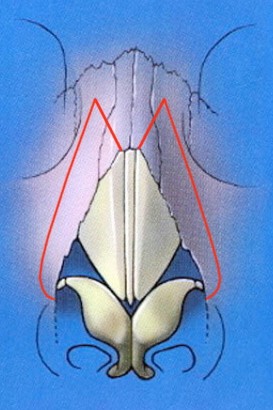
Planned osteotomy lines for nasal bridge narrowing
Contact us to arrange a consultation → | Rhinoplasty Surgery → | Rhinoplasty Risks →
Specialist Otolaryngologist & Head and Neck Surgeon
Specialist registration — Otorhinolaryngology, Head & Neck Surgery
View full profile
