Rhinoplasty FAQs
This page is intended as general information only and does not constitute medical advice. Every patient’s anatomy, goals, and circumstances are different — a thorough assessment at consultation is necessary. All cosmetic surgery involves risks and individual results vary.
Common questions about rhinoplasty surgery answered by Dr Jason Roth, Specialist Otolaryngologist and rhinoplasty surgeon, Sydney. Dr Roth performs more than 150 rhinoplasty procedures per year including primary, revision, functional, and cosmetic cases.
Full rhinoplasty information → | Rhinoplasty risks → | Arrange a consultation →
Rhinoplasty is surgery to change the shape, size, or function of the nose. It may be performed for cosmetic reasons (to alter the appearance of the nose), functional reasons (to improve nasal breathing), or both simultaneously. The term covers a wide range of procedures — from minor refinements to the nasal tip through to complex structural reconstruction involving cartilage grafting and framework rebuilding.
Rhinoplasty is widely regarded as one of the most technically demanding operations in surgery. The nose is a three-dimensional structure in which small changes to one area can have unpredictable effects on adjacent areas, and the final result does not become fully apparent until all swelling has resolved — a process that can take twelve to twenty-four months.
Rhinoplasty can address a wide range of structural and aesthetic concerns, including:
- A dorsal hump (bump on the bridge of the nose)
- A wide, bulbous, or boxy nasal tip
- A drooping or ptotic nasal tip
- A nose that appears too large or too small in proportion to the face
- Asymmetry of the nose, nostrils, or tip
- A deviated or crooked nose
- Wide nostrils (alar base reduction)
- A saddle nose deformity (loss of dorsal height)
- Nasal airway obstruction — deviated septum, nasal valve collapse, turbinate hypertrophy
- Problems resulting from a previous rhinoplasty (revision rhinoplasty)
What is achievable depends on the individual’s anatomy, skin thickness, and degree of change requested. A detailed assessment at consultation is necessary.
In open rhinoplasty, a small incision is made across the columella — the strip of skin between the nostrils — allowing the skin to be lifted and the underlying cartilage framework to be visualised and modified directly. In closed (endonasal) rhinoplasty, all incisions are made inside the nostrils, leaving no external scar.
Open rhinoplasty provides greater direct visualisation and is preferred for complex cases — tip work, revision surgery, and significant structural reconstruction. Closed rhinoplasty is appropriate for more limited changes and has a slightly shorter swelling phase. Dr Roth performs both approaches and will recommend the most appropriate technique for your anatomy and goals at consultation. Read more about open rhinoplasty →
Preservation rhinoplasty refers to techniques in which the nose is reshaped while maintaining the integrity of the osseocartilaginous dorsal roof — lowering it as a single intact unit rather than excising and reconstructing it. Advantages include a more natural-looking dorsum, reduced post-operative swelling, and a lower risk of middle vault collapse.
Preservation techniques are anatomy-dependent and work best in noses with a predominantly cartilaginous hump and non-excessively thick skin. Dr Roth attended the inaugural Preservation Rhinoplasty Conference in Nice (2019) and the Structure and Preservation Rhinoplasty Conference in Istanbul (2024). Read more about preservation rhinoplasty →
Rhinoplasty is performed by both Otolaryngologists (ENT surgeons) and Plastic Surgeons. The relevant distinction is the surgeon’s specific training, fellowship experience, and volume of rhinoplasty practice — not the specialty designation.
ENT surgeons with dedicated rhinoplasty fellowship training have specific expertise in the full surgical anatomy of the nose including the nasal airway, septum, turbinates, and sinuses, and can address functional and cosmetic concerns simultaneously. Dr Roth is a Specialist Otolaryngologist with dedicated rhinoplasty fellowship training in both the United States (Rush University Medical Center, Chicago) and Europe (Academic Medical Center, Amsterdam), holding the IBCFPRS and performing more than 150 rhinoplasty procedures per year.
A minimum of two consultations is required before any rhinoplasty proceeds — this is both a regulatory requirement and good practice. The first consultation establishes your goals, assesses your anatomy, and allows Dr Roth to advise whether surgery is appropriate. The second consultation confirms the plan, addresses remaining questions, and completes the consent process. There is no obligation to proceed after either appointment.
Computer imaging is a tool used to help communicate planned changes visually — giving both the patient and surgeon a shared reference point for the goals of surgery. It is useful for aligning expectations and ensuring both parties are working toward the same outcome.
Computer imaging is illustrative, not a guarantee. The image represents a planned goal, not a predicted result — the actual outcome depends on individual anatomy, skin quality, healing response, and surgical execution.
Good candidates for rhinoplasty share several characteristics:
- They have been considering the change for a significant period — not a recent or impulsive decision
- They have realistic expectations and understand that perfection is not the goal
- They understand the recovery timeline — the final result takes twelve to eighteen months
- They are in good general health and are non-smokers, or prepared to cease smoking before surgery
- They have had at least two thorough consultations and feel fully informed
Patients with moderate skin thickness typically achieve the most predictable results. Very thick skin may limit the degree of definition achievable. This is assessed at consultation. The lower age limit is generally 16 for girls and 17 for boys.
A GP referral is recommended and enables a Medicare rebate on the consultation fee. If you present without a referral, a consultation is still available but the Medicare rebate will not apply. For functional rhinoplasty (deviated septum, nasal breathing difficulty), a referral is particularly straightforward to obtain from your GP.
Yes — Dr Roth performs all rhinoplasty under general anaesthesia in an accredited private hospital. Most patients stay one night. Day surgery is possible for shorter procedures. Operating time varies from approximately 1.5 hours for straightforward primary rhinoplasty to six or more hours for complex revision cases requiring rib cartilage grafting.
Cartilage grafting is required in many rhinoplasty cases — particularly those involving tip refinement, structural support, middle vault reconstruction, or revision surgery. The most common source is the nasal septum, harvested during the same operation. When septal cartilage is insufficient, cartilage may be taken from the ear or rib.
For significant rib cartilage cases, Dr Roth’s preference is for irradiated cadaveric rib allograft where appropriate — this avoids a donor-site incision on the chest while providing structural cartilage of sufficient volume and rigidity. Whether this is the right choice in any individual case is assessed at consultation.
Most patients describe the discomfort as moderate and manageable with oral pain medication. The sensation most commonly reported is pressure or tightness rather than sharp pain. Nasal congestion due to swelling often causes more functional difficulty — particularly with sleeping — than pain itself.
- Days 1–7: External splint in place. Swelling and bruising most prominent, peaking around 48–72 hours. Rest at home.
- Days 7–10: Splint and sutures removed. Most patients presentable socially within two weeks.
- Weeks 2–4: Bruising resolved. Return to work and light activities. Avoid strenuous exercise.
- Months 1–3: 70–80% of swelling resolved. The nose is taking shape but not final — avoid making judgements.
- Months 12–18: Final result. Swelling fully resolved including at the tip.
Patients with thick skin may take the full 24 months for swelling to fully resolve.
Where nasal obstruction is caused by correctable structural problems — a deviated septum, nasal valve collapse, or enlarged turbinates — addressing these as part of rhinoplasty typically produces a substantial and durable improvement in breathing. The degree of improvement depends on which structural factors are contributing and whether all can be addressed simultaneously. Read more about septoplasty →
In some cases yes — rhinoplasty involving septoplasty and correction of the nasal architecture can improve sinus drainage. Where significant sinus disease coexists, functional endoscopic sinus surgery (FESS) can be performed at the same time as rhinoplasty. This is assessed at consultation. Read more about sinus surgery →
Rhinoplasty addressing significant structural nasal obstruction can reduce snoring severity in patients whose snoring is driven primarily by nasal blockage. However, snoring is often multifactorial — the pharyngeal airway, tongue, and soft palate all play roles that rhinoplasty does not address. A thorough assessment is needed to determine whether nasal surgery would be helpful in your specific situation. Read more about snoring management →
The broad shape of the result is typically evident by two to three months, once the major swelling has resolved. However, the fine detail — particularly of the nasal tip — continues to refine for twelve to twenty-four months. Concerns about the result that persist beyond twelve months can be discussed at that point. Revision surgery is not considered before twelve months, and eighteen months or more is preferable.
The cost depends on the complexity and extent of the surgery, whether it is a primary or revision procedure, whether cartilage grafts are required, and the hospital and anaesthetist fees. A full itemised quote covering all three components (surgeon’s fee, anaesthetist’s fee, and hospital fee) is provided at consultation. As a guide, the total for primary rhinoplasty in Sydney typically ranges from approximately $15,000 to $30,000 or more depending on complexity.
Medicare and private health insurance rebates are available for rhinoplasty where documented functional indications are present — for example, nasal obstruction from a deviated septum, nasal valve collapse, or enlarged turbinates. The relevant MBS item numbers (including item 45641 for septoplasty) attract a rebate from Medicare, and private health insurance may contribute to the gap and hospital fees.
Purely cosmetic rhinoplasty does not attract Medicare or private health insurance rebates. In many patients, functional and cosmetic concerns coexist. The rebatable components are identified at consultation and included in your itemised quote.
Rhinoplasty carries the general risks of surgery under general anaesthetic as well as nasal-specific risks including:
- Asymmetry — present to some degree in virtually all post-rhinoplasty noses
- Swelling that resolves slowly — particularly in patients with thick skin
- Over-resection or under-resection
- Middle vault collapse
- Nasal valve compromise
- Persistent deviation
- Skin healing problems — more common in smokers
- Unsatisfactory cosmetic result
- The need for revision surgery
A complete discussion of risks is provided at consultation. Full information is also available on the rhinoplasty risks page. All cosmetic surgery involves risks and individual results vary.
No — and any surgeon who suggests otherwise should be approached with caution. The goal of rhinoplasty is meaningful, natural-looking improvement proportionate to your individual facial features, not surgical perfection. Minor asymmetries and small irregularities are the norm rather than the exception. The revision rate for rhinoplasty in the surgical literature is approximately 5–15%, reflecting the inherent complexity of the procedure.
Yes, significantly. Smoking impairs wound healing by reducing tissue oxygenation, increasing the risk of skin necrosis over cartilage grafts, prolonging swelling, and increasing infection risk. Smoking cessation is required before rhinoplasty — typically for a minimum of four to six weeks before surgery and an equivalent period afterwards. This is a clinical requirement, not a preference.
Primary rhinoplasty is a first procedure on unscarred anatomy. Revision rhinoplasty is surgery after one or more previous procedures — the tissue planes are scarred, cartilage may have been removed or weakened, and the healing response is more unpredictable. Revision rhinoplasty is significantly more complex, typically requires cartilage grafting (often from the rib), takes longer, and produces less predictable results. Read more about revision rhinoplasty →
A minimum of twelve months after primary rhinoplasty is required before revision is considered, and eighteen months is preferable. Swelling resolves slowly and what appears to be a structural problem at six months may resolve by twelve to eighteen months. Operating prematurely risks revising a result that has not yet shown its final form.
If concerns arise after rhinoplasty, the first step is always to discuss them with Dr Roth at a follow-up appointment. Many concerns in the first twelve months — asymmetry, tip appearance, firmness — are attributable to ongoing swelling and resolve without intervention. No assessment of the result is meaningful until at least twelve months have passed. Where genuine problems exist after full swelling resolution, revision options are discussed honestly.
Yes. Patients who have had previous rhinoplasty with another surgeon and are considering whether revision is appropriate are welcome to consult with Dr Roth for an independent assessment. Consultation involves a thorough assessment of the current anatomy and an honest view of whether revision surgery is advisable, what it can realistically achieve, and what the risks would be. There is no obligation to proceed.
Dr Roth consults from Suite 4205, Level 2, 834 Pittwater Road, Dee Why NSW 2099, on Sydney’s Northern Beaches. The practice telephone number is (02) 9982 3439.
Dr Roth performs rhinoplasty at North Shore Private Hospital, Castlecrag Private Hospital, and Wyvern Private Hospital in Sydney. The choice of hospital depends on the nature of the procedure, availability, and patient circumstances, and is discussed at consultation.
To arrange a consultation, contact the practice by telephone on (02) 9982 3439 or submit an enquiry via the contact page. A GP referral is recommended and enables a Medicare rebate on the consultation fee.
Rhinoplasty Surgery → | Revision Rhinoplasty → | Rhinoplasty Risks → | Pre-Operative Information →
Dr Roth’s Clinical Perspective
The questions patients most commonly bring to a rhinoplasty consultation — and that I find most useful to answer directly — are about timing, recovery, and the risk of revision. On timing: I see patients who have been considering rhinoplasty for five or ten years and are finally ready, and patients who are presenting after a few weeks of thinking about it. Both are equally valid starting points. On recovery: the swelling at six weeks is not the final result. The nose at twelve months is the nose. Patients who understand this are less distressed during the healing period. On revision: a small percentage of rhinoplasties require a revision, and a surgeon who tells you their revision rate is zero is either not being honest or not following their patients long enough.
— Dr Jason Roth, MBBS, FRACS (ORL-HNS), IBCFPRS
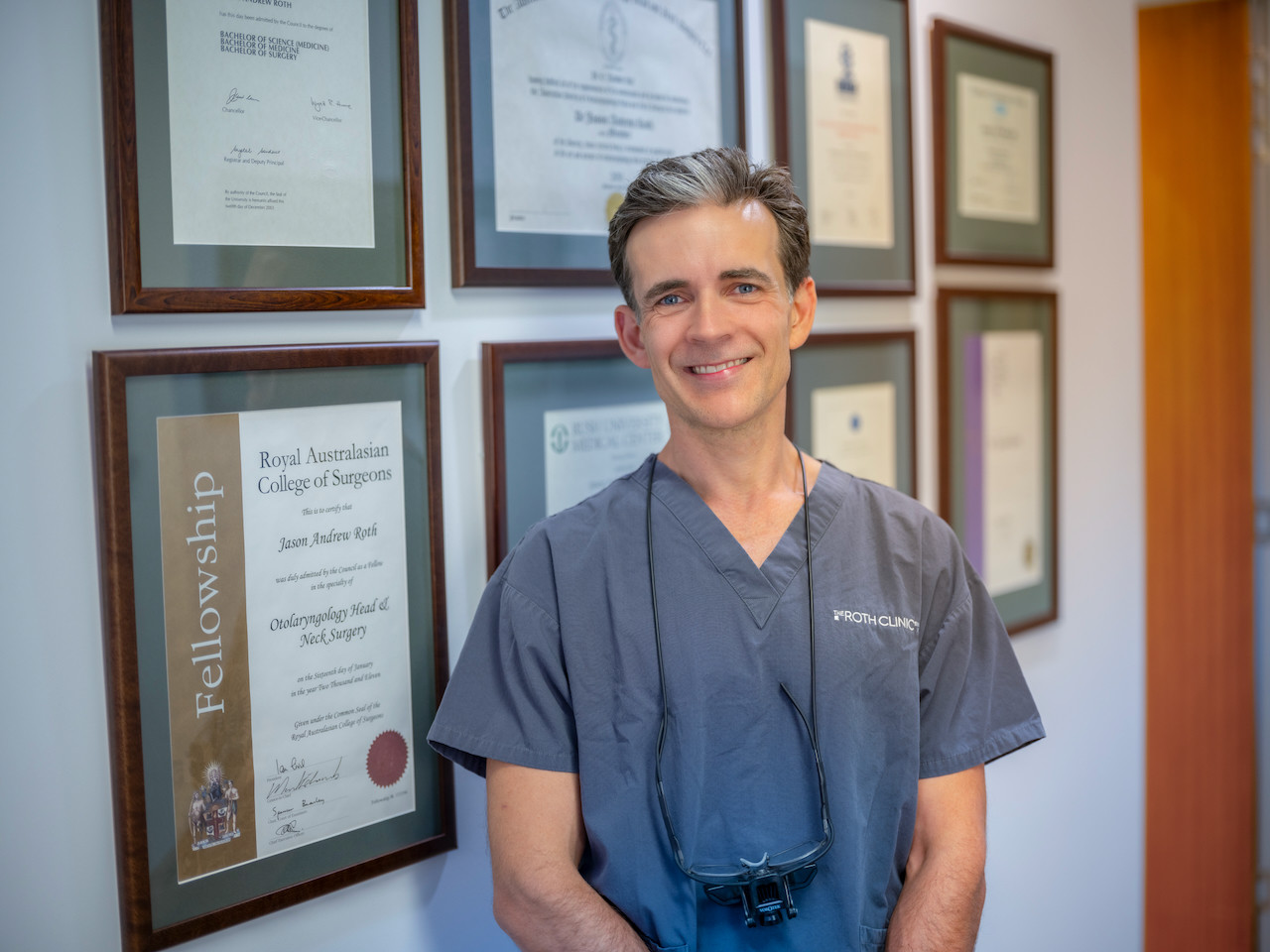
Specialist Otolaryngologist & Head and Neck Surgeon
Specialist registration — Otorhinolaryngology, Head & Neck Surgery
View full profile
