Facelift Scar Revision
All cosmetic surgery involves risks and individual results vary. Cosmetic surgery is a serious decision. Decisions about whether to proceed should be made after careful consideration and following at least two consultations with a qualified medical practitioner.
Facelift scars, when visible, are almost always a consequence of skin tension at closure — not simply poor healing. A facelift that has not adequately released the deeper retaining structures of the face will rely on the skin to maintain the lift, and skin under tension heals with a wider, more visible scar. Addressing that scar in isolation, without correcting the underlying cause, typically produces a temporary improvement that recurs.
Dr Roth sees patients who are concerned about the appearance of scars from a previous facelift — whether performed at this practice or elsewhere. The assessment focuses on why the scar looks the way it does, not just what the scar looks like.
Why Do Facelift Scars Become Visible?
Facelift incisions are placed in locations designed to be inconspicuous — within the hairline, in front of and behind the ear, and in the natural crease behind the tragus. When these scars heal well, they are difficult to detect even at close range. When they do not, the most common reason is tension.
Skin heals best when the wound edges come together without tension. In a facelift that has adequately released and repositioned the deeper facial structures — the SMAS, the retaining ligaments, and the platysma in the neck — the skin can be redraped and closed with minimal tension. The lift is maintained by the repositioned deep tissue, not by the skin itself.
In a facelift that has not addressed the deeper layers adequately, or where the technique relies primarily on skin advancement to achieve the result, the skin carries the load of the lift. Over time this produces two problems: the result deteriorates as the skin stretches, and the scar widens, thickens, or migrates as the tension is maintained at the wound edge. This is the most common pattern Dr Roth sees in patients presenting with visible facelift scars — a previous procedure that was insufficiently deep.
Other contributing factors include individual healing variation, infection or wound dehiscence at the time of the original surgery, keloid or hypertrophic scar tendency, and sun exposure during healing. These are assessed at consultation.
Assessment at Consultation
At consultation, Dr Roth assesses both the scar itself and the underlying facial anatomy. The key questions are whether residual skin tension is contributing to the scar appearance, whether the deeper facial structures have been adequately addressed by the previous surgery, and whether the overall facial result is satisfactory or whether there is also residual descent that warrants correction.
In many cases, the scar is inseparable from the result — a patient who had a facelift that relied primarily on skin tension will often have both a suboptimal aesthetic result and a visible scar. Treating the scar without addressing the result is a limited intervention. Dr Roth will discuss this directly at consultation.
Surgical Treatment — Deep Plane Facelift
Where residual skin tension is identified as the primary cause of scar visibility, the most durable solution is a deep plane facelift that properly releases the facial retaining ligaments and repositions the deeper soft tissue structures. Once the deeper structures are carrying the lift, the skin can be redraped and closed under minimal tension — which is the condition in which facelift scars heal most favourably.
This approach addresses both the scar and, where present, any residual facial descent from the original procedure. It is a more involved undertaking than isolated scar revision but produces a more durable outcome because the underlying cause has been corrected rather than the surface consequence treated in isolation.
For patients who had their original facelift performed elsewhere, Dr Roth will assess the anatomy carefully before recommending surgery. Operating in previously dissected tissue requires additional care and a clear understanding of what was done at the first operation. A minimum of two consultations is required before any surgical plan is agreed to.
Read more about the deep plane facelift →
Adjunctive Treatments
Following surgery, additional treatments may be used to optimise scar appearance during the healing phase and beyond. These are not alternatives to surgical correction where tension is the underlying problem, but complements to it.
Silicone scar gel — applied to the healed wound once sutures are removed, silicone gel is the most evidence-supported topical treatment for improving scar appearance. It is used consistently for several months following surgery.
Steroid injection — intralesional corticosteroid injection is used where a scar is hypertrophic or thickened. It softens and flattens the scar over a course of injections and can significantly improve the texture and profile of a raised scar.
UltraClear laser resurfacing — the practice’s 2,910nm fractional ablative laser can be used to improve scar texture and blending once the wound is fully healed, typically at three to six months following surgery. It is particularly useful for scars that have healed flat but remain visible due to textural difference from the surrounding skin. Read more about UltraClear →
Dr Roth’s Clinical Perspective
Most patients who come to see me about a facelift scar are actually presenting with the consequence of a facelift that did not release the deeper structures adequately. The scar is the visible sign of that — skin under tension, doing the work that the deeper dissection should have done. Treating the scar without addressing that is like painting over a crack in a wall that is still moving.
The conversation I have at consultation is therefore about the whole face, not just the scar. In most cases, a properly executed deep plane facelift allows the skin to be closed under no tension, and that is when scars heal well. The adjunctive treatments — silicone, steroid, laser — are useful and I use them, but they work best on a scar that has already healed in good conditions. They cannot fully compensate for a scar that is under ongoing tension.
I am also direct about what is achievable. A scar can be significantly improved — in many cases made very difficult to detect — but it cannot be erased. The goal is a scar that sits quietly in a position where it is not visible in ordinary social interaction. That is a realistic and achievable outcome in the right patient with the right approach.
— Dr Jason Roth, MBBS, FRACS (ORL-HNS), IBCFPRS
Deep Plane Facelift → | Revision Facelift → | UltraClear Laser → | Contact Us →
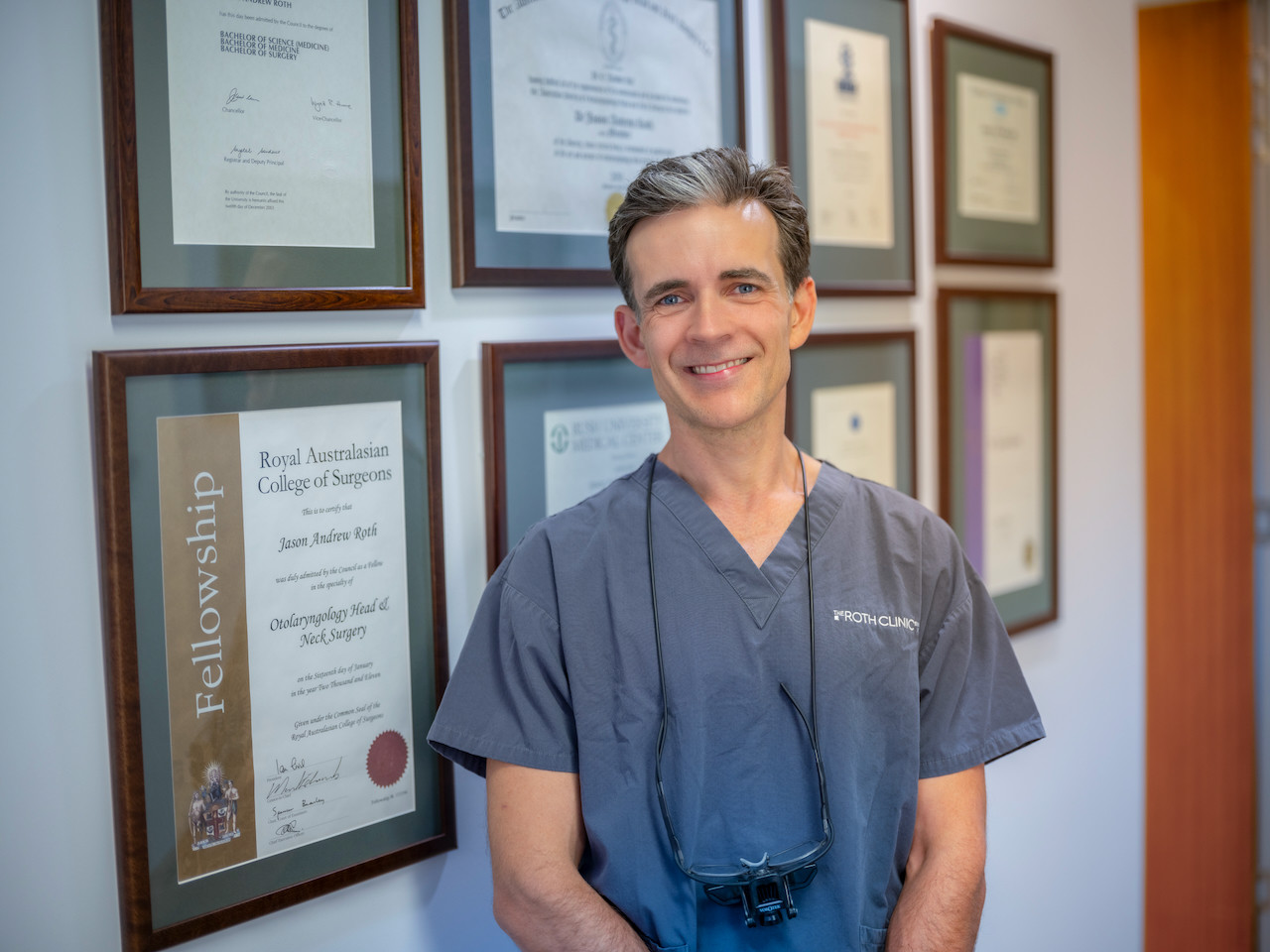
Specialist Otolaryngologist & Head and Neck Surgeon
Specialist registration — Otorhinolaryngology, Head & Neck Surgery
View full profile
