
Lateral Crural Strut Grafts
Lateral crural strut grafts are a rhinoplasty technique used to address problems of the lower lateral cartilages — the paired cartilages that form and support the nasal tip and alar sidewalls. They are used for both functional and structural purposes and are among the most versatile grafts in rhinoplasty surgery.
What Are the Lateral Crura?
The lower lateral cartilages consist of two portions — the medial crura, which form the columella and central tip support, and the lateral crura, which extend outward to form the alar rims and provide structural support to the nasal sidewalls and external nasal valve. The shape, position, and orientation of the lateral crura have a significant influence on both the appearance of the nasal tip and the function of the external nasal valve.
When the lateral crura are curved, malpositioned, or insufficiently strong, the result can be external nasal valve collapse during inspiration, a bulbous or poorly supported tip appearance, or both.
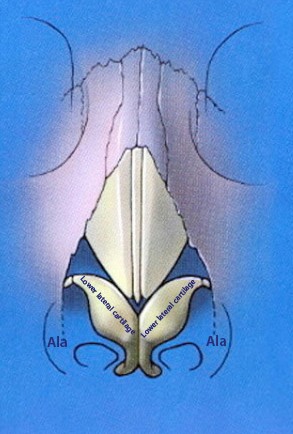
Lateral crura — nasal tip anatomy
What Do Lateral Crural Strut Grafts Do?
What Are the Grafts Made From?
Lateral crural strut grafts are made from a straight, relatively firm piece of cartilage — typically septal cartilage (first preference) or rib cartilage. The graft is carved into a rectangular strip of appropriate length and width and sutured to the undersurface of the lateral crus in a precise pocket.
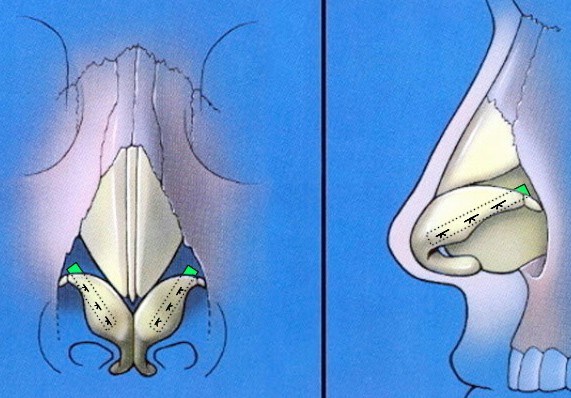
Lateral crural strut graft position — frontal and profile views
Contact us to arrange a consultation → | Nasal Valve Collapse → | Rhinoplasty Surgery →
Dr Roth’s Clinical Perspective
Lateral crural strut grafts are one of the techniques that has been partially superseded in my practice by lateral crural tensioning for bulbous and boxy tip correction — LCT achieves the repositioning and stiffening of the lateral crura without adding graft bulk to the nasal sidewall. That said, lateral crural strut grafts remain an important technique where there is genuine structural deficiency in the lateral wall — in revision cases where lateral crural cartilage has been over-resected, or where the wall is too weak to support tensioning alone. Understanding which approach is appropriate for a given anatomy is the decision that determines the outcome.
— Dr Jason Roth, MBBS, FRACS (ORL-HNS), IBCFPRS

Specialist Otolaryngologist & Head and Neck Surgeon
Specialist registration — Otorhinolaryngology, Head & Neck Surgery
View full profile
