Planning a Rhinoplasty
All cosmetic surgery involves risks and individual results vary. Cosmetic surgery is a serious decision. Decisions about whether to proceed should be made after careful consideration and following at least two consultations with a qualified medical practitioner.
Planning a rhinoplasty is a process that should unfold over weeks or months — not days. Rhinoplasty is widely regarded as one of the most technically demanding operations in surgery, with outcomes that depend on a complex interaction between surgical technique, individual anatomy, skin characteristics, and healing. A patient who arrives at surgery with a clear, realistic, and well-discussed understanding of what is planned — and what the realistic range of outcomes is — is far better placed than one who has rushed the decision.
This page describes the planning process in detail, from the first consultation through to the pre-operative appointment, and explains what patients should understand and consider before committing to surgery.
Cosmetic surgery is a serious decision. Read the full rhinoplasty risks page →
Before the First Consultation
Before attending a rhinoplasty consultation, it is worth taking time to understand your own goals as clearly as possible. What specifically concerns you about your nose? Is it one feature or several? Is the concern primarily about how the nose looks, how it functions (breathing), or both? Are there specific situations — photographs from certain angles, looking in the mirror in particular lighting — that prompt the concern most strongly? And how long have you had this concern — is it a long-standing issue or a more recent preoccupation?
These questions are worth reflecting on before consultation, because the answers shape the surgical planning discussion in important ways. A patient who can articulate their concerns clearly and specifically — “I would like the dorsal hump reduced but I want to keep a natural profile” — gives the surgeon a much more useful starting point than one who presents with a vague sense of dissatisfaction. At the same time, clarity about your goals should not tip into rigidity: the achievable result is determined by your anatomy, not by a pre-conceived image, and flexibility is an important part of approaching rhinoplasty with realistic expectations.
It can be helpful to bring photographs to the first consultation — photographs of yourself from different angles that illustrate the concerns clearly, and perhaps photographs of noses that appeal to you aesthetically (with the understanding that these are reference points for discussion, not targets). Computer imaging at consultation will help translate abstract goals into a more specific visual plan, but this is a communication tool rather than a prediction of outcome.
The First Consultation
The first rhinoplasty consultation with Dr Roth involves a thorough assessment of your nose — both externally and internally — and a detailed discussion of your goals, your anatomy, and what surgery can and cannot achieve in your individual case. It is not a commitment to proceed with surgery.
Medical History
Dr Roth will review your full medical history, including previous nasal surgery or trauma, medications, allergies, bleeding history, and general health. Certain medications — including aspirin, ibuprofen, and many supplements — must be ceased well in advance of surgery. Smoking significantly increases surgical and healing risks and cessation is required before rhinoplasty can be considered. Any history of mental health conditions — particularly body dysmorphic disorder — is also relevant and will be discussed sensitively.
External Nasal Assessment
The nose is assessed from the front, the sides (both profiles), from below (the base view), and from the three-quarter views. Each angle reveals different information about the nasal structure. The front view shows nasal width, tip definition, dorsal aesthetic lines, nostril shape, and symmetry. The lateral profile shows dorsal height, tip projection and rotation, the nasolabial angle, and the relationship of the nose to the forehead and chin. The base view shows nostril shape, columellar width, and the relationship between the tip structures and the nostril rims. Together these views allow Dr Roth to understand the three-dimensional character of your nose and identify the structural features contributing to your concerns.
Internal Nasal Assessment
The nasal airway is assessed with a nasal speculum and endoscopy, evaluating the septum for deviation, the turbinates for enlargement, the internal nasal valve for collapse or narrowing, and the presence of any mucosal pathology such as polyps. Functional assessment is an essential part of every rhinoplasty consultation — even in patients whose primary concern is cosmetic — because rhinoplasty that does not account for the nasal airway can inadvertently worsen breathing.
Skin Assessment
The skin of the nose is assessed for thickness, elasticity, and quality. Skin thickness is one of the most important variables in rhinoplasty planning. Thin skin is less forgiving — every minor framework irregularity will be visible through it, and the skin provides minimal concealment of the cartilage beneath. Thick skin limits the degree of tip definition achievable and prolongs the period of post-operative swelling, but provides better concealment of minor irregularities. Both extremes require different technique and produce different expectations.
Photographs and Computer Imaging
Standardised photographs are taken at the first consultation — front, both laterals, base, and oblique views — under consistent lighting. These serve as the baseline record and as the reference for computer imaging. Computer imaging involves digitally modifying the photographs to illustrate what a proposed surgical plan might look like in broad terms. This is a communication tool, not a prediction of outcome. It allows the patient and surgeon to establish that they share a common understanding of the goals, to identify any discrepancy in their respective ideas about what is desirable, and to refine the plan before surgery. The computer image does not account for skin behaviour, healing variability, or the intra-operative findings that may require the plan to be modified.
Discussion of Technique, Risks, and Recovery
Dr Roth will outline the proposed surgical approach, the techniques likely to be involved, the risks, and the realistic expectations for recovery and outcome. This discussion is candid: the revision rate, the prolonged timeline to final result, the variability of healing, and the specific risks relevant to your planned procedure are all discussed explicitly. Questions are encouraged at every stage.
Between the First and Second Consultation
The period between the first and second consultations is an important part of the planning process. It gives patients time to reflect on what was discussed, to ask any questions that arose after leaving the clinic, to consider whether the proposed plan aligns with their goals, and to decide whether they are genuinely ready to proceed. This time should not feel like a formality — it is an opportunity to ensure that the decision to proceed is made with full information and without pressure.
Patients are encouraged to:
- Review the written information provided at the first consultation
- Write down any questions that arose after the appointment and bring these to the second consultation
- Seek a second opinion if they wish — this is entirely appropriate and supported
- Discuss the decision with family members or trusted friends if they find this helpful
- Review the rhinoplasty risks page and the pre-operative information in full
- Begin the process of ceasing smoking and blood-thinning medications if relevant
The Second Consultation (Pre-Operative Appointment)
The second consultation is a dedicated pre-operative appointment, scheduled approximately two weeks before surgery. It serves several important functions:
Choosing the Right Timing for Surgery
Once a surgical plan is agreed and a booking made, the timing of surgery should be considered carefully from a practical and personal standpoint. Several factors are worth planning for:
- Work leave: Most patients take ten to fourteen days away from work. Those in public-facing or high-pressure roles may need longer to feel presentable and mentally settled. Remote or desk-based workers may return earlier.
- Social commitments: Significant events — weddings, major presentations, important travel — should not be scheduled within three months of rhinoplasty. The nose at two or three months does not represent the final result, and significant swelling may persist.
- Exercise and sport: Strenuous exercise must be avoided for two to three weeks. Contact sport — anything with risk of a blow to the nose — must be avoided for at least eight weeks and ideally longer.
- Sunlight: Significant sun exposure should be avoided for at least four weeks. Sun exposure on healing incisions causes pigmentation.
- Support at home: The first week after surgery requires help at home — someone to assist with daily tasks, particularly in the first forty-eight hours when sedation effects persist. This is especially important for patients with young children or other dependants.
- Emotional readiness: Surgery undertaken during a period of significant personal stress or major life disruption is associated with less satisfactory subjective outcomes. If something significant has changed in your personal circumstances between your initial consultation and your surgery date, it is worth discussing this with Dr Roth before proceeding.
Questions to Ask When Planning Rhinoplasty
The following questions are worth raising explicitly during the planning process. A surgeon who is experienced and transparent will be comfortable addressing all of them:
- What specific technique do you plan to use for my nose, and why?
- What are the most likely risks for my specific anatomy and planned procedure?
- What is your personal revision rate, and what happens if I am not happy with the outcome?
- What do you think is the most realistic result for my nose given my anatomy?
- What concerns, if any, do you have about whether I am a suitable candidate?
- How many rhinoplasties of this type do you perform per year?
- What continuing education in rhinoplasty have you completed in recent years?
- Am I likely to need general anaesthesia, and will I stay overnight in hospital?
Rhinoplasty Surgery Overview → | Am I a Candidate? → | Recovery — Month by Month → | Pre-Operative Information → | Rhinoplasty Risks → | Arrange a Consultation →
Dr Roth’s Clinical Perspective
The planning process for rhinoplasty is where outcomes are determined. A surgeon who can articulate specifically — before the operation — what they are going to do to each anatomical structure and why, is a surgeon who has genuinely planned the case. Computer imaging is a useful communication tool for discussing goals with the patient, but it is not a surgical plan — the plan is the set of specific surgical manoeuvres that will be applied to the specific anatomy, and that is what I discuss at the second consultation when the imaging has been reviewed and the approach confirmed.
— Dr Jason Roth, MBBS, FRACS (ORL-HNS), IBCFPRS
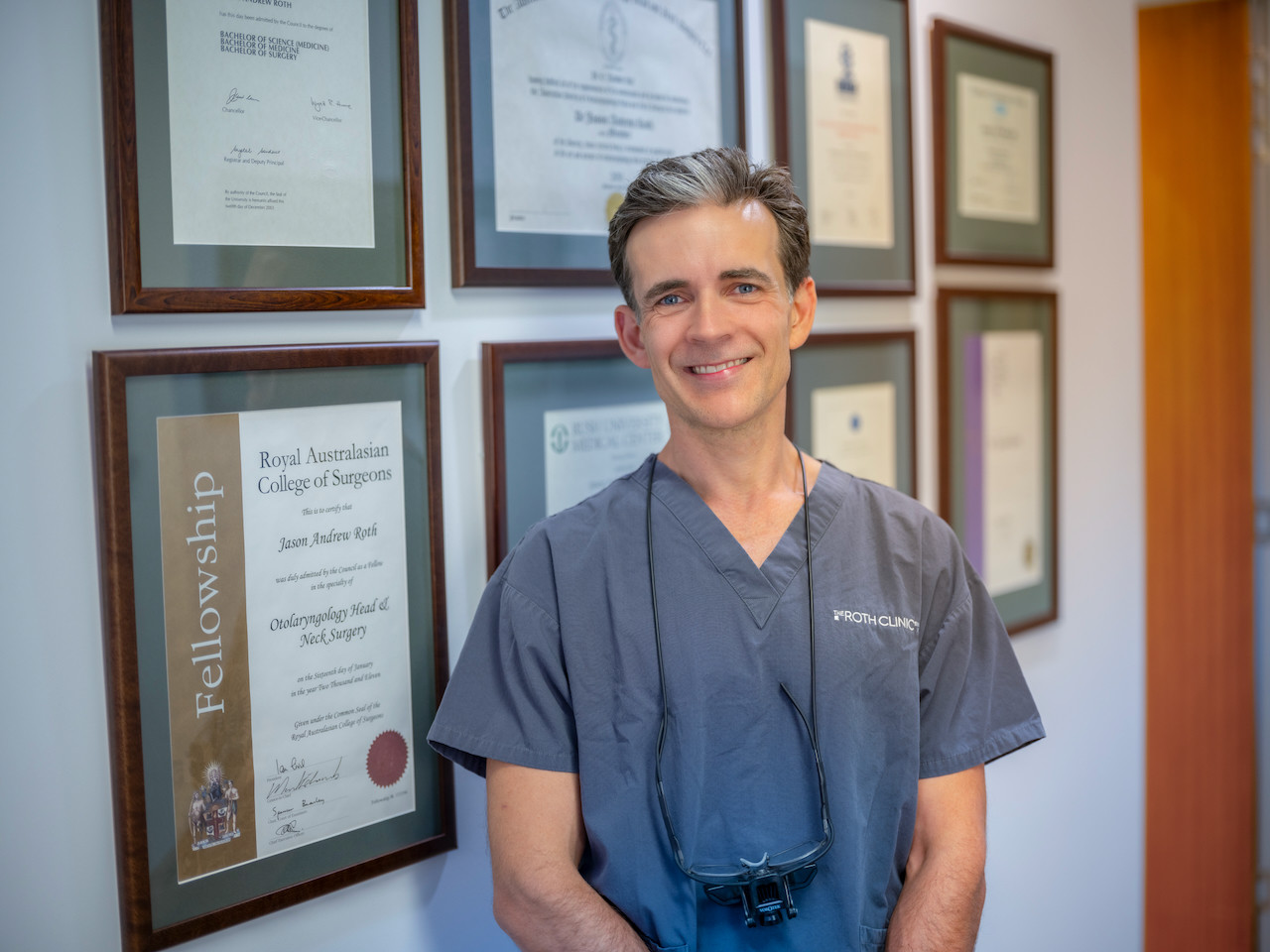
Specialist Otolaryngologist & Head and Neck Surgeon
Specialist registration — Otorhinolaryngology, Head & Neck Surgery
View full profile
