Primary Rhinoplasty
All cosmetic surgery involves risks and individual results vary. Cosmetic surgery is a serious decision. Decisions about whether to proceed should be made after careful consideration and following at least two consultations with a qualified medical practitioner.
Primary rhinoplasty refers to a rhinoplasty performed on a nose that has not previously undergone any surgical procedure. The distinction between primary and revision rhinoplasty is clinically significant: a primary rhinoplasty is performed in tissue that has not been disrupted by previous surgery, which means the anatomical planes are intact, the cartilage is in its original position and condition, the skin has not been scarred from a prior operation, and healing is more predictable. This does not mean primary rhinoplasty is simple — rhinoplasty is considered among the most technically demanding procedures in all of surgery regardless of whether it is primary or revision — but it does mean that the surgeon is working with the most favourable possible tissue conditions.
If you are considering rhinoplasty for the first time, thorough planning and a careful choice of surgeon are the most important factors in achieving a good outcome. Revision rhinoplasty — performed on a nose that has been previously operated on — is substantially more difficult, carries greater surgical risk, and has less predictable outcomes than primary surgery. The primary procedure is your best opportunity, and it is worth taking the time to plan it thoroughly.
Cosmetic surgery is a serious decision. Read the full rhinoplasty risks page →
What Makes Primary Rhinoplasty Different
Intact Anatomical Planes
The nose is dissected through a series of well-defined tissue planes — between the skin and the perichondrium overlying the cartilage, and between the cartilage and the deeper structures. In a primary nose, these planes are clean and consistent. In a previously operated nose, scar tissue obliterates these planes, making dissection more difficult, more time-consuming, and more prone to inadvertent injury of the skin or cartilage. Working in primary tissue allows the surgeon to navigate the anatomy with much greater confidence and efficiency.
Intact Cartilage Sources
Many rhinoplasty procedures require cartilage grafts to support, reshape, or reinforce the nasal framework. In a primary rhinoplasty, the full complement of available graft sources is present: the septal cartilage (the preferred graft source — straight, thin, and strong), the ear cartilage, and the rib. In revision rhinoplasty, septal cartilage is often depleted or absent, having been harvested in the original procedure, which forces the surgeon to rely on ear or rib cartilage — both of which are technically more challenging to work with and carry their own limitations.
More Predictable Healing
Healing after rhinoplasty involves the formation of scar tissue that envelops the operated structures, the gradual re-draping of the skin over the reshaped framework, and the slow resolution of post-operative swelling over many months. In primary rhinoplasty, this process — while variable between individuals — follows a broadly predictable trajectory. In revision rhinoplasty, the healing response is amplified: more scar tissue forms, the soft tissue envelope responds more aggressively to a second operation, and the risk of the scar tissue obscuring the underlying structural work is higher. This is one of the reasons that revision rhinoplasty outcomes are inherently less predictable than primary outcomes.
Better Skin Vascularity
The skin of the nose is supplied by a network of small blood vessels that run in the subcutaneous tissue. These vessels are preserved during careful primary rhinoplasty but may be disrupted or reduced by previous surgery, compromising the skin’s blood supply. Good blood supply is essential for wound healing, graft integration, and resistance to infection. Primary rhinoplasty is performed in tissue with intact vascularity — one of its most important advantages over revision.
Approach Selection — Open or Closed
Primary rhinoplasty can be performed through either an open approach (with a small incision across the columella allowing the skin to be elevated and the entire nasal framework visualised directly) or a closed approach (in which all incisions are made inside the nostrils, with no external scar). Both approaches can be used for primary rhinoplasty; the choice depends on what is being addressed and the degree of access required.
Preservation rhinoplasty — a newer family of techniques that reshape the nose while maintaining as much of the original anatomy intact as possible — is primarily used in primary cases, as it relies on operating in tissue that has not been previously disturbed. Where the anatomy is appropriate, Dr Roth may favour preservation techniques for primary rhinoplasty. For cases requiring significant structural reconstruction, complex tip work, or grafting, the open approach remains the most appropriate option regardless of whether it is a first-time procedure.
More detail on the approaches used in rhinoplasty is available on the following pages:
- Open Approach Rhinoplasty →
- Closed Approach Rhinoplasty →
- Preservation Rhinoplasty →
- Open Structure Rhinoplasty →
- Preservation vs Open Structure — Comparison →
The Importance of Getting Primary Rhinoplasty Right
Primary rhinoplasty is the most favourable surgical context for achieving a good result — but it is still a demanding procedure with a meaningful revision rate. Around one in twenty rhinoplasty patients requires further surgery. Adequate planning, thorough pre-operative assessment, honest expectation-setting, and careful surgeon selection are the most important modifiable factors in producing a satisfactory primary rhinoplasty outcome.
Several principles are particularly worth observing when planning a first rhinoplasty:
Do not allow the momentum of excitement to rush you into a surgical booking before you are genuinely ready. A rhinoplasty decision made in haste, or under social pressure, or at a time of personal stress, is more likely to result in dissatisfaction regardless of the technical quality of the outcome.
The achievable result is determined by your anatomy — not by what you have seen on social media, in before/after galleries, or in computer imaging. The computer image at consultation is a communication tool, not a contract. Ask your surgeon what he genuinely expects to be achievable for your specific nose, and be wary of any surgeon who does not engage honestly with this question.
Rhinoplasty expertise is developed through high-volume practice, dedicated training, and ongoing continuing education. Seek a surgeon whose primary clinical interest is rhinoplasty, who performs it regularly, and who can demonstrate ongoing engagement with contemporary technique. The rhinoplasty surgeons page discusses this in more detail.
Rhinoplasty Surgery Overview → | Rhinoplasty for Men → | Ethnic Rhinoplasty → | Planning a Rhinoplasty → | Revision Rhinoplasty → | Rhinoplasty Risks → | Arrange a Consultation →
Dr Roth’s Clinical Perspective
Primary rhinoplasty — operating on a nose that has not been previously operated on — is in one sense the most technically forgiving type of rhinoplasty because the anatomy is undisturbed. But the standards are high precisely because the result of a well-planned primary rhinoplasty on a good candidate should be excellent, and any shortcoming will be visible for life. I approach primary cases with the same systematic assessment as revision cases — not assuming that an unoperated nose is straightforward, but working through the anatomy methodically and planning accordingly.
— Dr Jason Roth, MBBS, FRACS (ORL-HNS), IBCFPRS
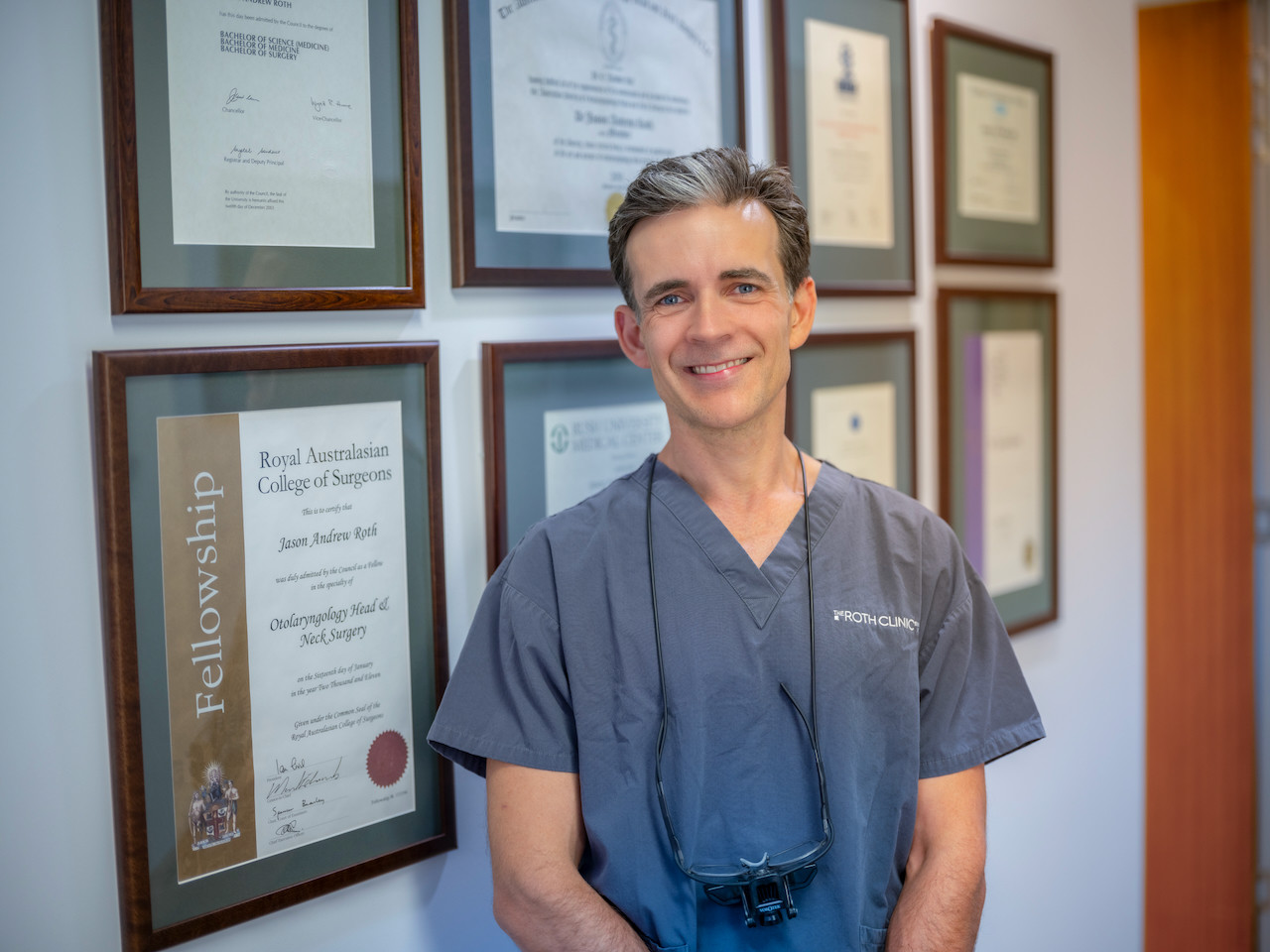
Specialist Otolaryngologist & Head and Neck Surgeon
Specialist registration — Otorhinolaryngology, Head & Neck Surgery
View full profile
